
Classes
Wunda Chair
Compact but demanding, the Wunda Chair trains balance, precision and lower-body power in a small footprint. Every repetition asks for control — there is nowhere to hide.
What you'll gain
Balance and stability
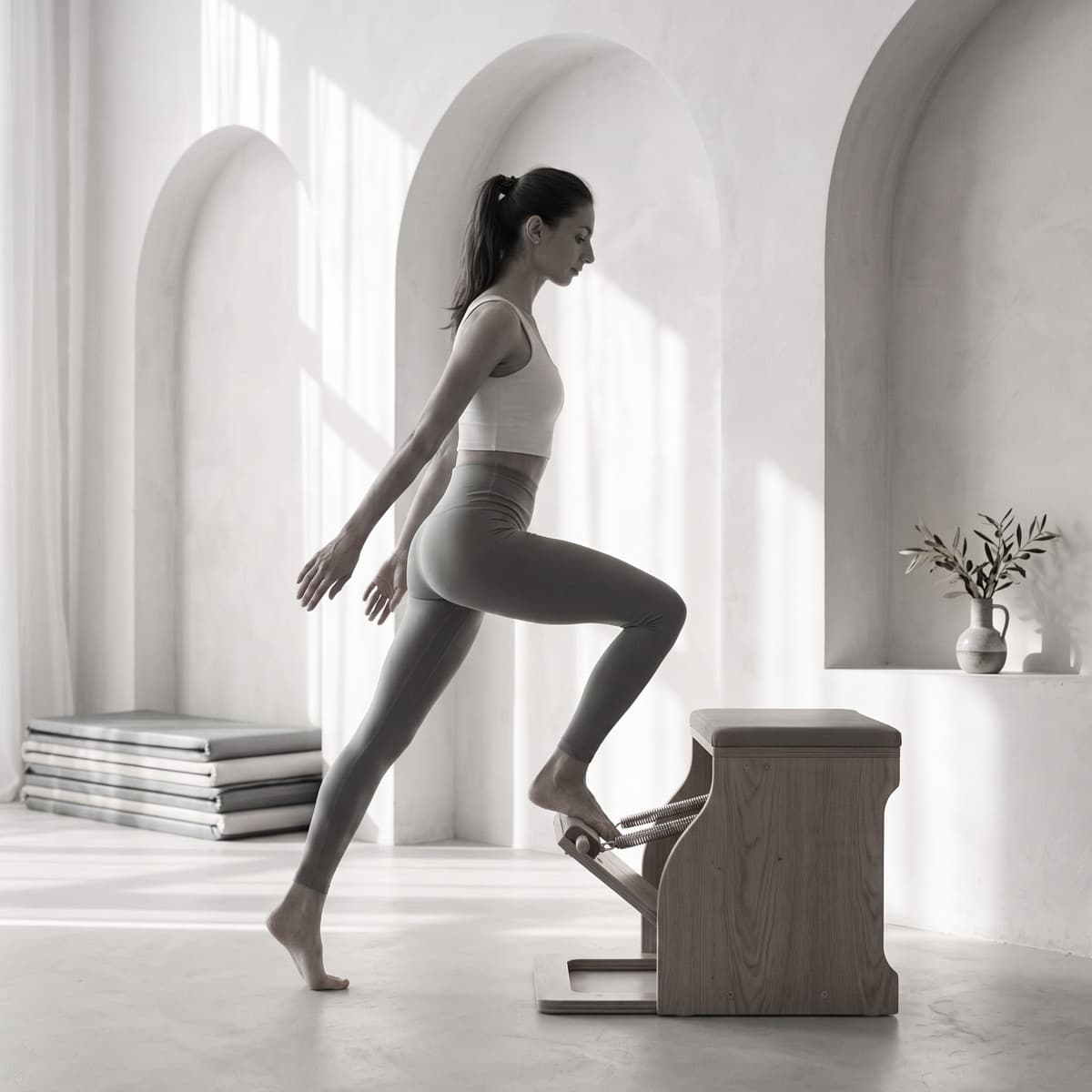
The Wunda Chair is small and unstable by design, so your body has to work to stay steady on it. Standing, sitting or pressing on the pedal, you recruit the deep muscles that keep you balanced — the ones that quietly hold you upright all day.
Lower-body power
Pressing the spring-loaded pedal builds real strength through the legs, hips and glutes. Because you often work one side at a time, the Chair finds and corrects the imbalances a larger machine can hide.
Precise, controlled movement
Every exercise on the Chair is slow, deliberate and unforgiving — nowhere to rush and nowhere to hide. You learn to move from your centre, with control in both directions of the spring.
That precision carries into daily life: standing from a chair, climbing stairs, lifting and reaching all feel steadier. It is functional, everyday strength you can use — not just strength you can measure.
The Wunda Chair, explained
The Wunda Chair is one of the original pieces of Pilates apparatus — a compact box with a spring-loaded pedal. Joseph Pilates designed it to fit into a small flat and still demand everything of the body using it. A century on, it remains one of the most challenging tools in the studio precisely because it is so small. There is little to lean on and nothing to hide behind, so the work falls to your own strength, balance and control.
On the Chair you press, lift and balance against the springs — standing on it, sitting on it, or working from the floor beside it. The pedal can be loaded lightly or heavily, and exercises are often done one leg or one arm at a time. Every repetition is slow and deliberate: the Chair rewards precision over power, so a movement that looks simple asks for real concentration.
We teach the Wunda Chair in small groups of no more than four, so your instructor watches every repetition and adjusts the springs and the exercise to you. It is an intermediate class, and it pairs well with reformer and mat work. Come twice a week and you will feel the difference in your balance, your legs and the ease with which you move through the day.
Class details
At a glance
Duration — 45 minutes. Group size — up to 4. Level — intermediate.
**Tip:**New here? Your first class is 35 GEL. Read how often to practise here.
Who it's for
This class is for those chasing balance, control and lower-body strength who want to move with real precision. The Wunda Chair is an intermediate class, so a little Pilates or movement experience helps — tell us your background when you book and we'll pitch the session to you. New to the studio? Begin on the reformer or mat, then step up to the Chair when you're ready.
Not sure where to start?
Tell us your goals and any injuries, and we will suggest the right first class to start with.
Book a class